
Making It through the Rankings Maze
Rankings can tell you what or who the “best” is. What they can’t (or choose not to) tell you is that rankings often sacrifice context in the pursuit of scale and comparability. Rankings are, in other words:
A measure of compliance rather than a measure of performance;
A cultural indication of what people value instead of what they like;
An indication of the resources and access that participants have rather than their vision.
Despite the acknowledged limitations of rankings, many of us believe that we have no choice but to participate in the rankings game. Whether we are rankings providers, the entities that they rank, or the final consumers of rankings, we feel compelled to enter the maze and stumble our way through it, if only by trial and error, sometimes losing sight of what lies ahead.
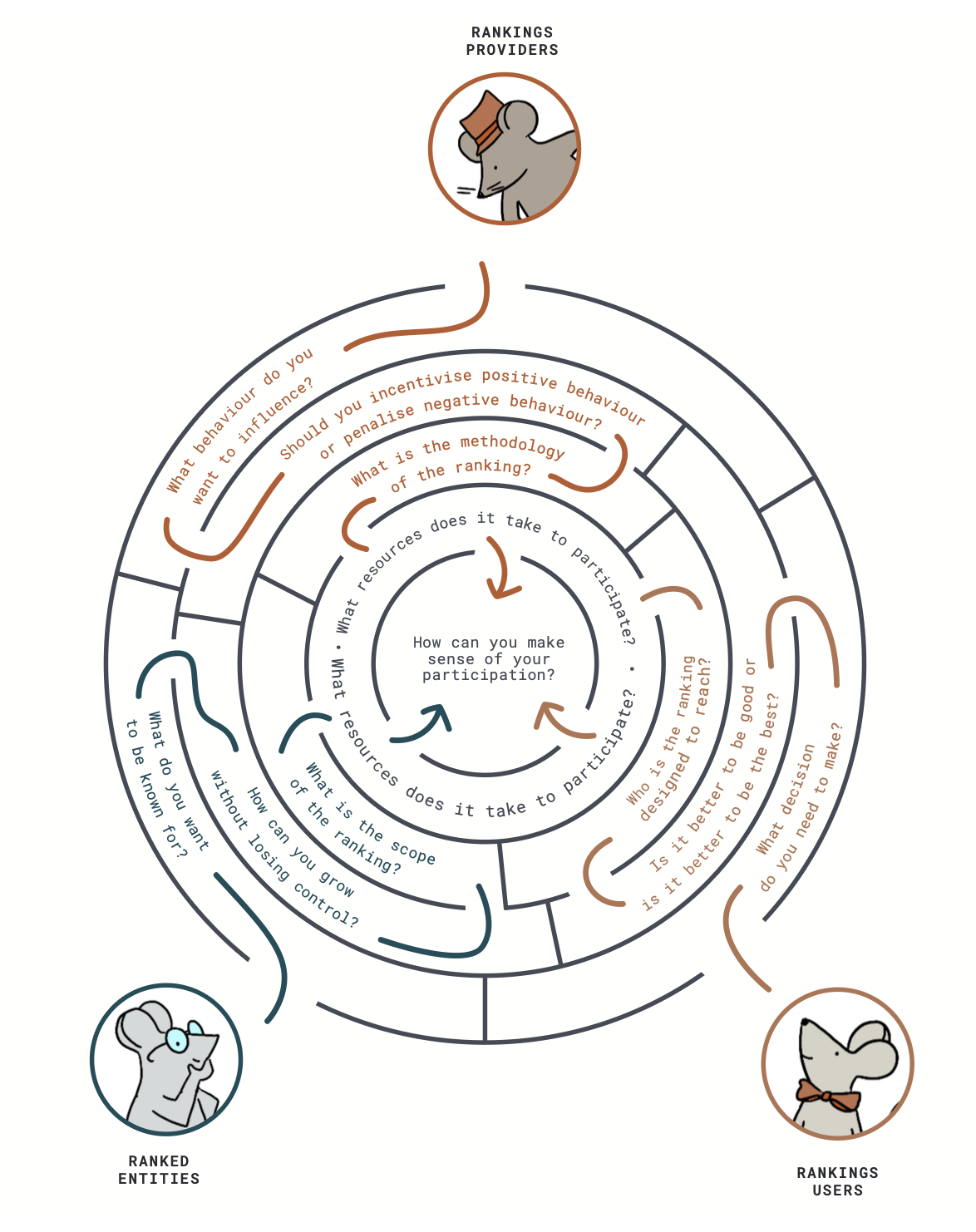
Making Rankings Work for You.
Instead of focusing on how to improve their rankings, leaders should focus on how to use rankings to make better decisions. The challenge is that rankings are often only available after the battle has been fought and are not designed specifically for anyone. Given these limitations, leaders should focus on what rankings aim to achieve instead of blindly following their results.
First, it is worth acknowledging that rankings can contribute to effective decision-making in three important ways, providing:
Clarity: Rankings simplify complexity, even at the risk of removing nuance and context.
Consistency: Rankings provide a natural pecking order, even if the criteria are disputed.
Convergence: Rankings create an audience, albeit not always one of our choosing.
Despite the utility of rankings, however, many managers and firms fall victim to three common pitfalls in their use. These errors include relying on rankings for:
Problem-solving: Relying on many underlying assumptions—and oftentimes opaque methods—rankings don’t help us understand how issues unfold at different scales.
Target setting: Goodhart’s Law states that “when a measure becomes a target, it ceases to be a good measure.” To that, we would add that there can’t be multiple winners in a zero-sum game.
Yardsticks for reward: Rankings provide an incentive to manipulate the measure to achieve the outcome we desire, instead of performing better on a shared vision.
Like any tool, rankings serve a function, and it is up to leaders to use them effectively. Below, we have outlined three ways in which rankings can improve organisational performance, and steps that managers can take to integrate rankings into their decision-making and evaluation.
1.Adopt a systematic perspective
By translating intangible notions into actual levers, rankings help develop a systematic perspective. Create a correspondence table that links ranking categories to internal initiatives, considering the relevance and significance of each ranking category for your organisation.
2.Bring context
Given the amount of information covered and their capacity to create categories, rankings are a good source of insights into competitors, as well as a formidable benchmarking tool. Pit rankings scores against the objective constraints faced in addressing them to identify patterns, trends, and performance pathways.
3.Develop narratives
Rankings are a way to mediate the reciprocal asymmetry of information between an organisation and its stakeholders, facilitating increased advocacy efforts from both sides. Leverage the weightings assigned to ranking categories and stakeholders’ conversations about ranking scores to bring your agenda to the boardroom.
© Baptiste Raymond - tembocitizen.com