
Simultaneous Leadership
No pun intended, but managing intergenerational challenges is an age-old debate that we may approach in turn as either "old fogeys" or "young fools."
To make sense of our leadership journey, we need a "before" and an "after": juniors and seniors as witnesses of our progress. Remember the first days of middle school, when you felt so different from primary school kids, and yet could feel the distance between you and high schoolers?
Managers can afford to think linearly because effectiveness often requires hierarchy. However, young generations challenging the legitimacy of experience and tenure invite leaders to view leadership as a simultaneous, multifaceted experience.
Think of it as an optical effect: from afar, individual journeys seem to have a clear direction, but from up close, they reveal a series of defining moments connected through storytelling.
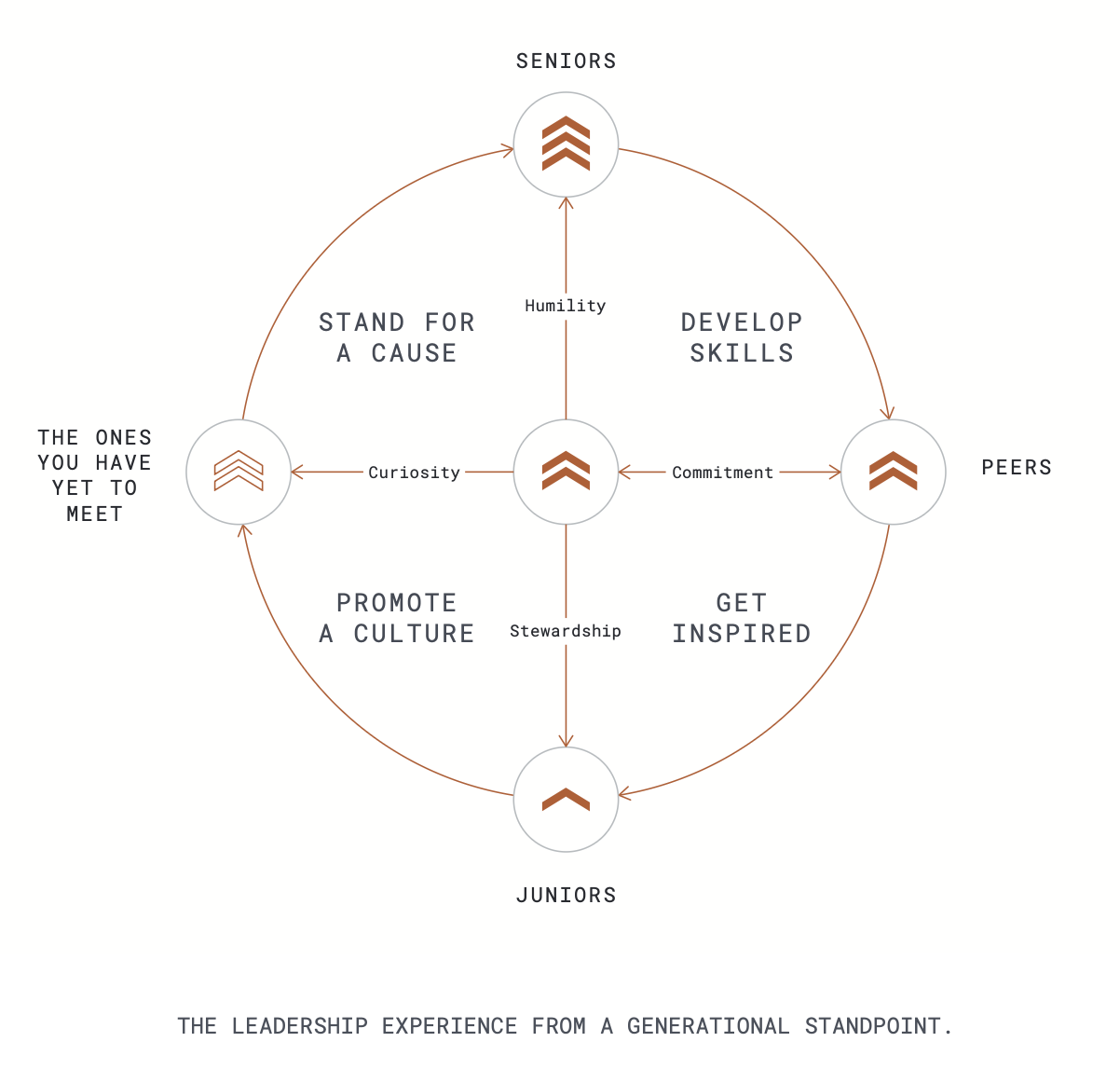
Taking generational challenges as an invitation to reflect on our leadership style, we outline four dimensions where leaders must embrace simultaneity.
Simultaneity of needs. Career lifecycle is often presented in stages centred around sequential needs such as inspiration, skill-building, commitment, and knowledge-sharing. If it is true that there are no shortcuts (e.g., a skilful commitment is more meaningful than good intentions), moving beyond a strictly linear view of our careers can unlock leadership potential. Juniors can consider that even without training, they can have a meaningful contribution from day one by conveying an open-minded attitude. Let others be reminded that a leader who stands for a cause but stops learning risks irrelevance and someone who promotes culture without accountability risks becoming more of a guru than a guide.
Simultaneity of locus. We often separate the systems that impose themselves on us (work, family, etc.) from the ones we choose (hobbies, civic activities, etc.), differentiating how each environment can help address our leadership needs. This cultural separation introduces a kind of duality in leadership, explaining why boardrooms can still be detached from the societal impact of their decisions. Regardless of age, the possibility to claim or reject belonging to a community marks the beginning of the leadership journey. It reframes the traditional junior/senior hierarchy into a horizontal relationship between peers who have made a similar choice and fellow strangers who adhere to similar values, creating a shared responsibility for the outcomes of decisions.
Simultaneity of relationships. At any time, we are simultaneously junior to some and senior to others. It is even clearer if you consider the simultaneity of locus first: for example, a CEO starting a new hobby is still a beginner. This acknowledgement fosters healthy intergenerational relationships: humility regarding seniority and stewardship toward our juniors. To avoid submissive or condescending behaviours, consider that within a senior-junior relationship, there are areas in which the mentor is the mentee, and the other way round. This is true for skills (try to teach your elders new technologies) and more spiritual matters (see the disarray of some adults regarding younger loved ones).
Simultaneity of sense-making. As leaders work to make sense of a situation, so too do those they lead, those who lead them, and others they may not even be aware of. Providing context helps align these perceptions. However, context must go beyond insider information because decisions apply to everyone. Hence, how a decision is received is as important as the insider information that presided over it.
Providing both vertigo and relief, the simultaneity of the leadership experience is at the root of collaboration and creative possibilities beyond what leaders can achieve through planning.
Simultaneous leadership is not easy as it introduces constant negotiations on the ‘why’, the ‘where’, the ‘who’, and the ‘how’. This may leave us dizzy and thwart management attempts to progress projects if the presence of alternatives becomes an excuse to avoid responsibility.
Setting boundaries acts as an antidote, empowering the leadership-shy and containing the leadership-full. A clear framework provides everyone with a common sense of stewardship by defining valued ways of working, ultimately shaping a culture and traditions to be passed on to the next generations of leaders.
© Baptiste Raymond - tembocitizen.com